Correlations sand
-
pyeng.geotechnical.correlations.sand.frictionangle_overburden_kleven(sigma_vo_eff, relative_density, Ko=0.5, max_friction_angle=45.0, fail_silently=True, **kwargs)¶ This function calculates the friction angle according to the chart proposed by Kleven (1986). The function takes into account the effective confining pressure of the sand and its relative density. The function was calibrated on North Sea sand tests with confining pressures ranging from 10 to 800kPa. Lower confinement clearly leads to higher friction angles. The fit to the data is not excellent and this function should be compared to site-specific testing or other correlations.
Parameters: - sigma_vo_eff – Effective vertical stress (\(\sigma \prime _{vo}\)) [\(kPa\)] - Suggested range: 10.0<=sigma_vo_eff<=800.0
- relative_density – Relative density of sand (\(D_r\)) [\(Percent\)] - Suggested range: 40.0<=relative_density<=100.0
- Ko – Coefficient of lateral earth pressure at rest (\(K_o\)) [\(-\)] (optional, default=0.5) - Suggested range: 0.3<=Ko<=2.0
- max_friction_angle – The maximum allowable effective friction angle (\(\phi \prime _{max}\)) [\(deg\)] (optional, default=45.0)
Returns: Peak drained friction angle (\(\phi_d\)) [\(deg\)], Mean effective stress (\(\sigma \prime _m\)) [\(kPa\)]
Return type: Python dictionary with keys [‘phi [deg]’,’sigma_m [kPa]’]
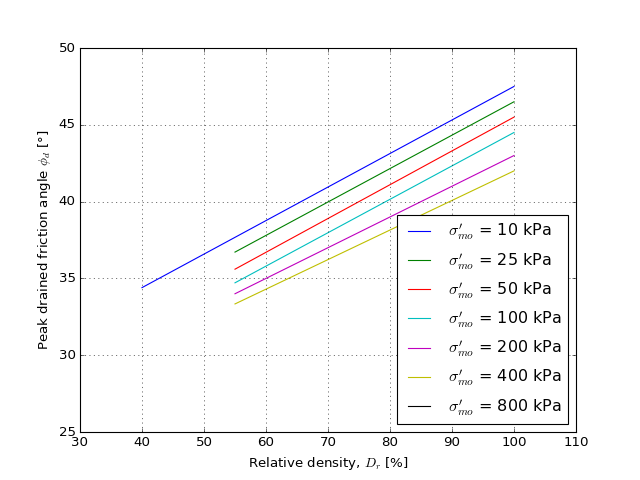
Data and interpretation chart according to Kleven (Lunne et al (1997))
Reference - Lunne, T., Robertson, P.K., Powell, J.J.M. (1997). Cone penetration testing in geotechnical practice. SPON press
- Examples:
>>>phi = friction_angle_kleven(sigma_vo_eff=100.0,relative_density=60.0,Ko=1.0)['phi [deg]']
35.8
-
pyeng.geotechnical.correlations.sand.gmax_cptsand_lunne(cone_resistance, sigma_vo_eff, coefficient_1=1634.0, coefficient_2=-0.75, **kwargs)¶ Calculates the small-strain shear modulus or uncemented quartz sand from cone tip resistance. The correlation is based on the results of field and calibration chamber tests.
At low values of the normalised cone resistance, the uncertainty on the estimate is greater. This is likely due to variations in soil compressibility
Parameters: - cone_resistance – Cone tip resistance (\(q_c\)) [\(MPa\)] - Suggested range: 0.0 <= cone_resistance <= 120.0
- sigma_vo_eff – Vertical effective stress (\(\sigma_{vo}^{\prime}\)) [\(kPa\)] - Suggested range: sigma_vo_eff >= 0.0
- coefficient_1 – First calibration coefficient (multiplier) (:math:``) [\(-\)] (optional, default= 1634.0)
- coefficient_2 – Second calibration coefficient (exponent) (:math:``) [\(-\)] (optional, default= -0.75)
\[\left( \frac{G_{max}}{q_c} \right)_{ave} = 1634 \cdot \left( \frac{q_c}{\sqrt{\sigma_{vo}^{\prime}}} \right)^{-0.75}\]Returns: Dictionary with the following keys: - ’Gmax [kPa]’: Small-strain shear modulus (\(G_{max}\)) [\(kPa\)]
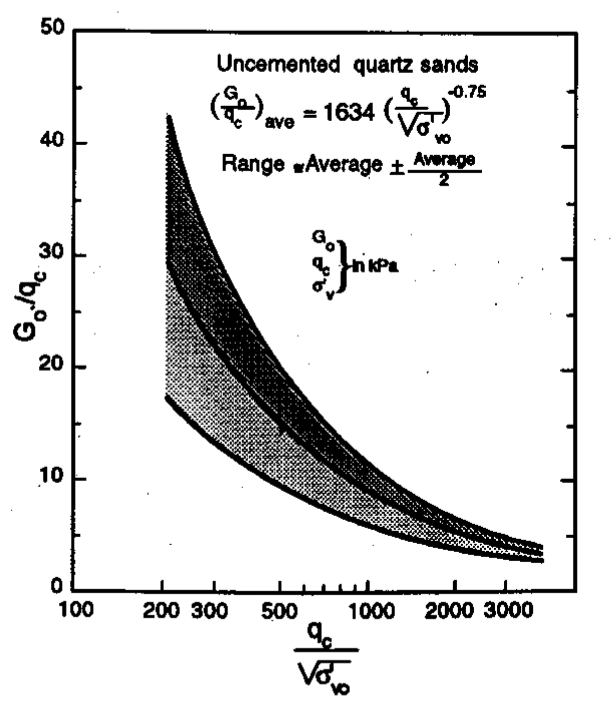
Ranges of the correlation
Reference - Lunne, T., Robertson, P.K., Powell, J.J.M., 1997. Cone penetration testing in geotechnical practice. E & FN Spon.
-
pyeng.geotechnical.correlations.sand.lateralearthpressure_relativedensity_bellotti(relative_density, fail_silently=True, **kwargs)¶ Calculates the coefficient of lateral earth pressure at rest from sand relative density. The underlying data was gathered using calibration chamber testing on sands of different relative density.
Parameters: relative_density – Relative density of sand (\(D_r\)) [\(\%\)] - Suggested range: 20.0<=relative_density<=100.0 Returns: Coefficient at lateral earth pressure at rest (\(Ko\)) [\(-\)] Return type: Python dictionary with keys [‘Ko [-]’] 
Coefficient of lateral earth pressure at rest for normally consolidated sand based on relative density
Reference - Bellotti et al. (1985). Laboratory validation of in-situ tests. Italian Geotechnical Society Jubilee Volume, XI ICSMFE, San Francisco