Correlations clay
-
pyeng.geotechnical.correlations.clay.gmax_cptclay_maynerix95(cone_resistance, density, coefficient_1=1.75, coefficient_2=0.627, **kwargs)¶ Calculates the small-strain shear modulus for intact and fissured clays. This relation is used when initial void ratio is difficult to estimate.
Parameters: - cone_resistance – Cone tip resistance (\(q_c\)) [\(MPa\)] - Suggested range: 0.0 <= cone_resistance <= 120.0
- density – Density of the soil material (\(\rho\)) [\(kg/m3\)] - Suggested range: 1000.0 <= density <= 3000.0
- coefficient_1 – First coefficient (multiplier) in the correlation (:math:``) [\(-\)] (optional, default= 1.75)
- coefficient_2 – Second coefficient (exponent) in the correlation (:math:``) [\(-\)] (optional, default= 0.627)
\[ \begin{align}\begin{aligned}V_s = 1.75 \cdot (q_c)^{0.627}\\G_{max} = \rho \cdot V_s^2\end{aligned}\end{align} \]Returns: Dictionary with the following keys: - ’Vs [m/s]’: Shear wave velocity (\(V_s\)) [\(m/s\)]
- ’Gmax [kPa]’: Small-strain shear modulus (\(G_{max}\)) [\(kPa\)]
Reference - Ameratunga, J., Sivakugan, N., Das, B.M., 2016. Correlations of Soil and Rock Properties in Geotechnical Engineering. Springer, India.
-
pyeng.geotechnical.correlations.clay.lateralearthpressure_plasticity_massarsch(plasticity_index, fail_silently=True, **kwargs)¶ Calculates the coefficient of lateral earth pressure at rest from the plasticity index for a normally consolidated clay. The correlation is based on a number of tests on normally consolidated italian clays. For PI<20%, the correlation overestimates the coefficient of lateral earth pressure at rest.
Parameters: plasticity_index – Plasticity index (\(PI\)) [\(\%\)] - Suggested range: 20.0<=plasticity_index<=70.0 Returns: Ko (\(Ko\)) [\(-\)] Return type: Python dictionary with keys [‘Ko [-]’] 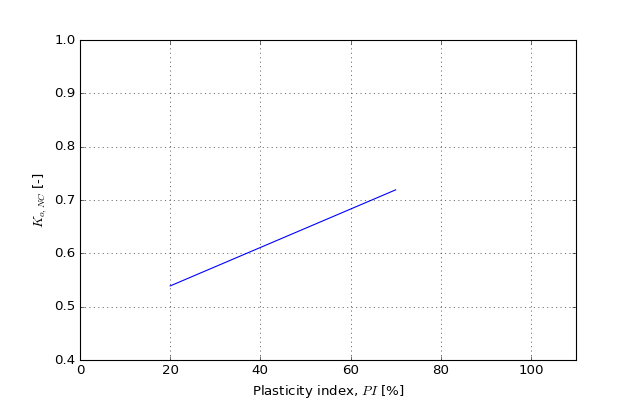
Correlation between coefficient of lateral earth pressure at rest and plasticity index for normally consolidated Italian clays
Reference - Massarsch K.R. (1979). Lateral earth pressure in normally consolidated clay. 8th ECSMFE, Brighton, 2: 245-249
-
pyeng.geotechnical.correlations.clay.secondarycompressionratio_watercontent_mesri(water_content, fail_silently=True, **kwargs)¶ For a given clay the logarithm of the secondary compression ratio \(C_{\alpha \epsilon}\) shows a linear correlation with the logarithm of the natural water content. Note that the secondary compression ratio is NOT equal to the ratio of the secondary compression index \(C_{\alpha}\) to the compression index \(C_c\). The definitions are given in the equations below.
Parameters: water_content – Natural water content of the clay (\(w\)) [\(\%\)] - Suggested range: 10.0<=water_content<=2000.0 \[ \begin{align}\begin{aligned}C_{\alpha \epsilon} = \frac{C_{\alpha}}{1 + e_o}\\\text{Organic soft clays} \quad C_{\alpha}/C_c = 0.05 \pm 0.01\\\text{Inorganic soft clays} \quad C_{\alpha}/C_c = 0.04 \pm 0.01\\\text{Sands} \quad C_{\alpha}/C_c = 0.015 \pm 0.03\end{aligned}\end{align} \]Returns: Secondary compression ratio (\(C_{\alpha \epsilon}\)) [\(\%\)] Return type: Python dictionary with keys [‘secondary_compression_ratio [%]’] 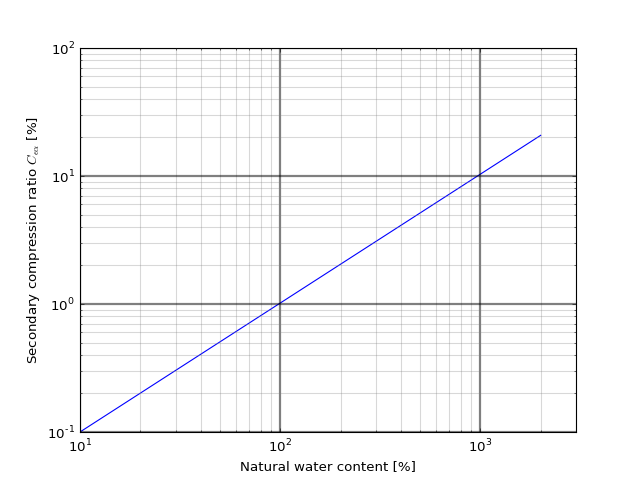
Secondary compression ratio vs water content based on data from 12 natural clays
Mesri G, Godlewski P.M. (1977). Time and stress-compressibility interrelationship. Journal of Geotechnical Eng. Division, ASCE, GT5: 417-430.